
# IPTV Encoder Technology Compression Protocols and Professional Streaming Explained
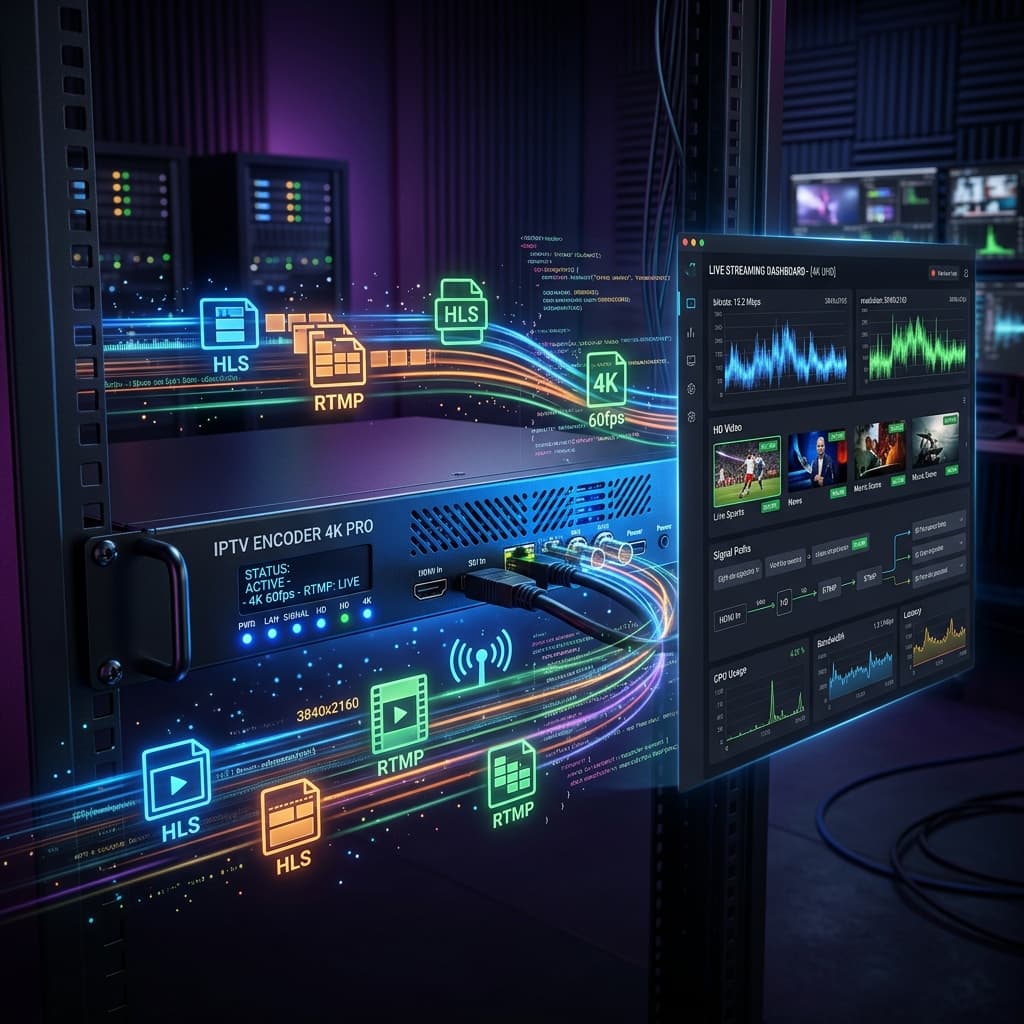
The iptv encoder stands at the very heart of every professional and consumer digital television streaming operation worldwide. Understanding how an iptv encoder works at a technical level enables broadcasters, streaming service providers, and home entertainment enthusiasts to make informed decisions about their video distribution infrastructure. With the global shift toward four K Ultra HD content delivery, selecting the right iptv encoder has become a critical factor in guaranteeing a premium viewing experience for every subscriber.
In this comprehensive technical analysis exceeding thirteen hundred words, we thoroughly explore the world of iptv encoder technology. We break down H.264 and H.265 HEVC video compression standards, examine real time streaming protocols including HLS, RTMP, and SRT, compare hardware versus software encoder solutions, explain how Eagle4k leverages advanced encoding infrastructure to power its four K Ultra HD streaming platform, and answer the most frequently asked questions from industry professionals and streaming enthusiasts.
## What Is an IPTV Encoder and How Does It Operate
An iptv encoder is a dedicated hardware device or a specialized software application whose primary function is to capture raw video from a source such as a camera, satellite receiver, or capture card, compress that video into an optimized digital stream, and transmit it over IP networks to media servers and subscriber devices in real time. This encoding process transforms uncompressed video data into a compact, network friendly format without compromising perceptible picture quality.
The technical workflow inside a modern iptv encoder involves several sequential operations. First, the device digitizes the incoming analog or digital video signal into raw uncompressed frames at the target resolution and frame rate. Second, a compression algorithm such as H.264 AVC or H.265 HEVC is applied to reduce the raw data volume by exploiting spatial redundancy within individual frames and temporal redundancy across consecutive frames. Third, the compressed video stream is packaged into a transport container format such as MPEG TS or fragmented MP4 and transmitted to distribution servers using real time streaming protocols like RTMP, HLS, SRT, or RTSP.
## Video Compression Technologies Behind the IPTV Encoder
The choice of video codec embedded in an iptv encoder is arguably the single most impactful technical decision in any streaming deployment. The two dominant standards in the industry are H.264 AVC and H.265 HEVC.
H.264 AVC remains the most widely deployed video compression standard in the global digital television industry. Its exceptional compatibility with virtually every playback device on the market makes it the default choice for broadcasters requiring maximum reach. An iptv encoder using H.264 can deliver high definition content at resolutions up to ten eighty progressive with bitrates ranging from two to six megabits per second while maintaining excellent perceptual quality for a broad audience.
H.265 HEVC represents the next major evolution in video compression efficiency beyond H.264. This codec achieves equivalent visual quality at roughly fifty percent lower bitrate, making it the preferred choice for four K Ultra HD streaming deployments. An iptv encoder implementing H.265 can broadcast four K content at sixty frames per second using fifteen to twenty five megabits per second, dramatically reducing the bandwidth requirements of large scale streaming operations. Eagle4k has deployed H.265 HEVC encoding throughout its infrastructure to deliver uncompressed four K quality at competitive subscription rates.
AV1 is an emerging royalty free video codec that surpasses even H.265 in compression efficiency. As hardware support expands across Smart TV platforms and mobile devices, iptv encoders incorporating AV1 will increasingly define the next era of ultra efficient streaming.
## Hardware and Software IPTV Encoder Solutions Compared
The global market offers two fundamental categories of iptv encoder solutions, each with distinct advantages suited to different deployment scales and use cases.
Dedicated hardware iptv encoders are professional appliances built specifically for real time video compression and delivery. These units integrate application specific integrated circuits or field programmable gate arrays that perform the computationally intensive encoding operations at speeds far exceeding what general purpose computer processors can achieve. Leading hardware encoder brands such as Haivision, Matrox, Teradek, and Vitec offer rackmount units capable of encoding multiple simultaneous four K streams with sub second latency. Hardware encoders are the preferred solution for broadcast grade deployments demanding uninterrupted continuous operation over extended production periods.
Software iptv encoders run on standard computers and exploit the processing capacity of the host CPU or GPU to perform video compression. Popular platforms including OBS Studio, FFmpeg, Wirecast, and vMix enable operators to build fully featured software encoding pipelines at a fraction of the hardware cost. GPU acceleration technologies such as Nvidia NVENC and Intel Quick Sync Video substantially reduce CPU load on the host machine, enabling software iptv encoders to approach hardware encoder performance on modern workstations equipped with capable graphics cards.
## Streaming Protocols That Work Alongside the IPTV Encoder
The streaming protocol selected for use alongside an iptv encoder determines how efficiently encoded video data is transported from the encoding point to media distribution servers and ultimately to subscriber devices.
RTMP or Real Time Messaging Protocol was developed by Adobe and has become a foundational protocol for live stream ingestion. An iptv encoder pushing RTMP output to a media server is a common configuration for live sports broadcasting and event streaming. RTMP delivers low latency stream delivery and wide compatibility with media server platforms including Wowza Streaming Engine and Nginx RTMP Module.
HLS or HTTP Live Streaming was developed by Apple and has evolved into the universal standard for adaptive bitrate streaming over the public internet. An iptv encoder producing HLS output segments the live video into small numbered chunks distributed via ordinary HTTP web servers. This design ensures compatibility with every web browser and connected device on the market while enabling adaptive quality adjustment based on each viewer's available bandwidth.
SRT or Secure Reliable Transport is a modern open source protocol specifically engineered for reliable transmission of high quality video streams over unpredictable public internet connections. An iptv encoder sending SRT output can recover from packet loss and network jitter automatically, maintaining consistent stream quality even on challenging network paths.
## How Eagle4k Uses Advanced IPTV Encoder Infrastructure for Four K Streaming
Eagle4k has built its streaming platform on a foundation of professional grade iptv encoder hardware installed in enterprise data centers across Europe and North America. Every channel in our catalog is processed through dedicated H.265 HEVC encoding hardware before being distributed over our high capacity content delivery network to subscribers worldwide.
Our encoding architecture implements an adaptive bitrate ladder that simultaneously produces multiple quality renditions of each live stream, from standard definition for viewers on limited mobile connections up to uncompressed four K Ultra HD at sixty frames per second for subscribers watching on large screen Smart TVs. The Anti Freeze version nine point zero platform developed by Eagle4k monitors every encoding node in real time and automatically reroutes streams to standby encoders within milliseconds in case of hardware failure, delivering uptime exceeding ninety nine point nine percent.
This professional iptv encoder infrastructure is what enables Eagle4k to offer over twenty thousand live channels and a VOD library of more than one hundred sixty thousand titles in consistent four K quality across Samsung, LG, Android TV, Firestick, and Apple TV devices.
## Optimal Configuration Parameters for a High Performance IPTV Encoder
Achieving the best possible streaming performance from any iptv encoder requires careful attention to several interdependent technical parameters.
The video bitrate is the most fundamental setting to configure correctly. For ten eighty progressive high definition using H.264, a bitrate of four to six megabits per second delivers excellent results. For four K Ultra HD at sixty frames per second using H.265 HEVC, a bitrate between fifteen and twenty five megabits per second ensures sharp, artifact free imagery at all times.
The keyframe interval or GOP size directly affects how quickly a stream recovers after a brief network interruption. A two second keyframe interval is widely regarded as the industry standard for live streaming via iptv encoder.
Profile and level settings within H.264 and H.265 define the encoding complexity used during compression. High profile encoding extracts the maximum compression efficiency from the codec but demands more processing power from both the iptv encoder hardware and the decoding device. Choosing the appropriate profile based on the capabilities of target playback hardware is essential for broad device compatibility.
## Frequently Asked Questions and Answers About IPTV Encoder
Question one. What is the practical difference between a hardware and software iptv encoder?
Answer. Hardware iptv encoders deliver lower latency, superior stability during long broadcasts, and dedicated processing power, while software encoders offer greater flexibility and lower upfront cost for smaller productions.
Question two. Which video compression codec should I use in my iptv encoder?
Answer. H.265 HEVC is strongly recommended for four K Ultra HD streaming because it achieves equivalent picture quality to H.264 at roughly half the required bitrate.
Question three. What streaming protocol pairs best with an iptv encoder for live sports?
Answer. SRT is ideal for live sports production on unstable internet connections due to its built in error recovery, while HLS ensures maximum compatibility for final delivery to viewer devices.
Question four. How does Eagle4k use iptv encoder technology to maintain four K quality?
Answer. Eagle4k operates professional H.265 HEVC hardware encoders in European and North American data centers with automatic failover and a nine point zero Anti Freeze redundancy system.
Question five. Can I try the Eagle4k streaming quality before subscribing?
Answer. Yes, Eagle4k provides a free twenty four hour trial account that lets you experience four K picture quality powered by our professional iptv encoder infrastructure on your own television.
## Conclusion
The iptv encoder is the technological engine that transforms raw video signals into the seamless four K streaming experience modern viewers expect. Eagle4k harnesses the full potential of this technology through a professional encoding infrastructure designed for reliability and picture perfection. Request your free twenty four hour trial today and see the difference professional iptv encoder technology makes.
The iptv encoder stands at the very heart of every professional and consumer digital television streaming operation worldwide. Understanding how an iptv encoder works at a technical level enables broadcasters, streaming service providers, and home entertainment enthusiasts to make informed decisions about their video distribution infrastructure. With the global shift toward four K Ultra HD content delivery, selecting the right iptv encoder has become a critical factor in guaranteeing a premium viewing experience for every subscriber.
In this comprehensive technical analysis exceeding thirteen hundred words, we thoroughly explore the world of iptv encoder technology. We break down H.264 and H.265 HEVC video compression standards, examine real time streaming protocols including HLS, RTMP, and SRT, compare hardware versus software encoder solutions, explain how Eagle4k leverages advanced encoding infrastructure to power its four K Ultra HD streaming platform, and answer the most frequently asked questions from industry professionals and streaming enthusiasts.
## What Is an IPTV Encoder and How Does It Operate
An iptv encoder is a dedicated hardware device or a specialized software application whose primary function is to capture raw video from a source such as a camera, satellite receiver, or capture card, compress that video into an optimized digital stream, and transmit it over IP networks to media servers and subscriber devices in real time. This encoding process transforms uncompressed video data into a compact, network friendly format without compromising perceptible picture quality.
The technical workflow inside a modern iptv encoder involves several sequential operations. First, the device digitizes the incoming analog or digital video signal into raw uncompressed frames at the target resolution and frame rate. Second, a compression algorithm such as H.264 AVC or H.265 HEVC is applied to reduce the raw data volume by exploiting spatial redundancy within individual frames and temporal redundancy across consecutive frames. Third, the compressed video stream is packaged into a transport container format such as MPEG TS or fragmented MP4 and transmitted to distribution servers using real time streaming protocols like RTMP, HLS, SRT, or RTSP.
## Video Compression Technologies Behind the IPTV Encoder
The choice of video codec embedded in an iptv encoder is arguably the single most impactful technical decision in any streaming deployment. The two dominant standards in the industry are H.264 AVC and H.265 HEVC.
H.264 AVC remains the most widely deployed video compression standard in the global digital television industry. Its exceptional compatibility with virtually every playback device on the market makes it the default choice for broadcasters requiring maximum reach. An iptv encoder using H.264 can deliver high definition content at resolutions up to ten eighty progressive with bitrates ranging from two to six megabits per second while maintaining excellent perceptual quality for a broad audience.
H.265 HEVC represents the next major evolution in video compression efficiency beyond H.264. This codec achieves equivalent visual quality at roughly fifty percent lower bitrate, making it the preferred choice for four K Ultra HD streaming deployments. An iptv encoder implementing H.265 can broadcast four K content at sixty frames per second using fifteen to twenty five megabits per second, dramatically reducing the bandwidth requirements of large scale streaming operations. Eagle4k has deployed H.265 HEVC encoding throughout its infrastructure to deliver uncompressed four K quality at competitive subscription rates.
AV1 is an emerging royalty free video codec that surpasses even H.265 in compression efficiency. As hardware support expands across Smart TV platforms and mobile devices, iptv encoders incorporating AV1 will increasingly define the next era of ultra efficient streaming.
## Hardware and Software IPTV Encoder Solutions Compared
The global market offers two fundamental categories of iptv encoder solutions, each with distinct advantages suited to different deployment scales and use cases.
Dedicated hardware iptv encoders are professional appliances built specifically for real time video compression and delivery. These units integrate application specific integrated circuits or field programmable gate arrays that perform the computationally intensive encoding operations at speeds far exceeding what general purpose computer processors can achieve. Leading hardware encoder brands such as Haivision, Matrox, Teradek, and Vitec offer rackmount units capable of encoding multiple simultaneous four K streams with sub second latency. Hardware encoders are the preferred solution for broadcast grade deployments demanding uninterrupted continuous operation over extended production periods.
Software iptv encoders run on standard computers and exploit the processing capacity of the host CPU or GPU to perform video compression. Popular platforms including OBS Studio, FFmpeg, Wirecast, and vMix enable operators to build fully featured software encoding pipelines at a fraction of the hardware cost. GPU acceleration technologies such as Nvidia NVENC and Intel Quick Sync Video substantially reduce CPU load on the host machine, enabling software iptv encoders to approach hardware encoder performance on modern workstations equipped with capable graphics cards.
## Streaming Protocols That Work Alongside the IPTV Encoder
The streaming protocol selected for use alongside an iptv encoder determines how efficiently encoded video data is transported from the encoding point to media distribution servers and ultimately to subscriber devices.
RTMP or Real Time Messaging Protocol was developed by Adobe and has become a foundational protocol for live stream ingestion. An iptv encoder pushing RTMP output to a media server is a common configuration for live sports broadcasting and event streaming. RTMP delivers low latency stream delivery and wide compatibility with media server platforms including Wowza Streaming Engine and Nginx RTMP Module.
HLS or HTTP Live Streaming was developed by Apple and has evolved into the universal standard for adaptive bitrate streaming over the public internet. An iptv encoder producing HLS output segments the live video into small numbered chunks distributed via ordinary HTTP web servers. This design ensures compatibility with every web browser and connected device on the market while enabling adaptive quality adjustment based on each viewer's available bandwidth.
SRT or Secure Reliable Transport is a modern open source protocol specifically engineered for reliable transmission of high quality video streams over unpredictable public internet connections. An iptv encoder sending SRT output can recover from packet loss and network jitter automatically, maintaining consistent stream quality even on challenging network paths.
## How Eagle4k Uses Advanced IPTV Encoder Infrastructure for Four K Streaming
Eagle4k has built its streaming platform on a foundation of professional grade iptv encoder hardware installed in enterprise data centers across Europe and North America. Every channel in our catalog is processed through dedicated H.265 HEVC encoding hardware before being distributed over our high capacity content delivery network to subscribers worldwide.
Our encoding architecture implements an adaptive bitrate ladder that simultaneously produces multiple quality renditions of each live stream, from standard definition for viewers on limited mobile connections up to uncompressed four K Ultra HD at sixty frames per second for subscribers watching on large screen Smart TVs. The Anti Freeze version nine point zero platform developed by Eagle4k monitors every encoding node in real time and automatically reroutes streams to standby encoders within milliseconds in case of hardware failure, delivering uptime exceeding ninety nine point nine percent.
This professional iptv encoder infrastructure is what enables Eagle4k to offer over twenty thousand live channels and a VOD library of more than one hundred sixty thousand titles in consistent four K quality across Samsung, LG, Android TV, Firestick, and Apple TV devices.
## Optimal Configuration Parameters for a High Performance IPTV Encoder
Achieving the best possible streaming performance from any iptv encoder requires careful attention to several interdependent technical parameters.
The video bitrate is the most fundamental setting to configure correctly. For ten eighty progressive high definition using H.264, a bitrate of four to six megabits per second delivers excellent results. For four K Ultra HD at sixty frames per second using H.265 HEVC, a bitrate between fifteen and twenty five megabits per second ensures sharp, artifact free imagery at all times.
The keyframe interval or GOP size directly affects how quickly a stream recovers after a brief network interruption. A two second keyframe interval is widely regarded as the industry standard for live streaming via iptv encoder.
Profile and level settings within H.264 and H.265 define the encoding complexity used during compression. High profile encoding extracts the maximum compression efficiency from the codec but demands more processing power from both the iptv encoder hardware and the decoding device. Choosing the appropriate profile based on the capabilities of target playback hardware is essential for broad device compatibility.
## Frequently Asked Questions and Answers About IPTV Encoder
Question one. What is the practical difference between a hardware and software iptv encoder?
Answer. Hardware iptv encoders deliver lower latency, superior stability during long broadcasts, and dedicated processing power, while software encoders offer greater flexibility and lower upfront cost for smaller productions.
Question two. Which video compression codec should I use in my iptv encoder?
Answer. H.265 HEVC is strongly recommended for four K Ultra HD streaming because it achieves equivalent picture quality to H.264 at roughly half the required bitrate.
Question three. What streaming protocol pairs best with an iptv encoder for live sports?
Answer. SRT is ideal for live sports production on unstable internet connections due to its built in error recovery, while HLS ensures maximum compatibility for final delivery to viewer devices.
Question four. How does Eagle4k use iptv encoder technology to maintain four K quality?
Answer. Eagle4k operates professional H.265 HEVC hardware encoders in European and North American data centers with automatic failover and a nine point zero Anti Freeze redundancy system.
Question five. Can I try the Eagle4k streaming quality before subscribing?
Answer. Yes, Eagle4k provides a free twenty four hour trial account that lets you experience four K picture quality powered by our professional iptv encoder infrastructure on your own television.
## Conclusion
The iptv encoder is the technological engine that transforms raw video signals into the seamless four K streaming experience modern viewers expect. Eagle4k harnesses the full potential of this technology through a professional encoding infrastructure designed for reliability and picture perfection. Request your free twenty four hour trial today and see the difference professional iptv encoder technology makes.