
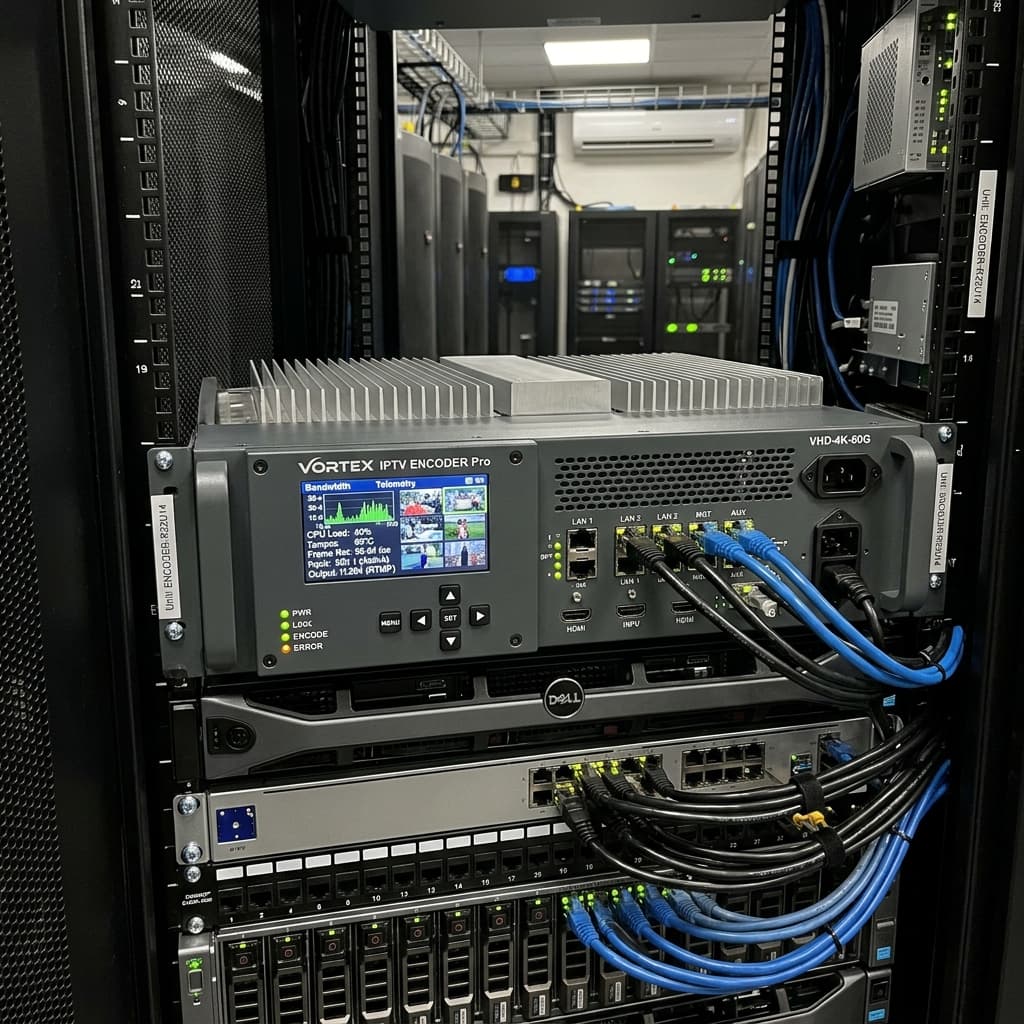
# Technical Architecture and Performance Analysis of Low Latency IPTV Encoder Hardware for High Speed Digital Broadcasting
The global digital media delivery landscape is undergoing a revolutionary transformation as broadcast operators and streaming services transition away from traditional satellite distribution toward real time internet protocol media transmission. Reducing signal transmission delay is the single most essential requirement for delivering live sporting matches, interactive broadcasting, breaking news feeds, and multiplayer gaming events. Deploying a low latency iptv encoder represents the core technological foundation for achieving sub second video delay from broadcast capture to subscriber display screens. Evaluating low latency iptv encoder options requires examining vital engineering parameters including hardware compression acceleration, multi protocol streaming transport support, spatial video quality optimization, dynamic bitrate allocation, and high availability edge network compatibility. High performance encoding systems must process high bitrate video sources cleanly while eliminating frame buffering bottlenecks during peak traffic periods. In this detailed technical analysis, we explore how low latency iptv encoder units process broadcast feeds, evaluate key network transmission benchmarks, outline step by step configuration procedures, answer common operator questions, and explain how pairing professional hardware encoders with the Eagle4k cloud distribution network guarantees maximum stream stability and pristine four K visual clarity.
## Understanding the Network Architecture of a Low Latency IPTV Encoder
To understand how high speed video streaming works, it is important to analyze the underlying hardware and software design powering a low latency iptv encoder. Traditional media encoding systems rely on large temporal frame buffers and heavy compression passes, which introduce several seconds of signal delay between the camera feed and viewer screens.
In contrast, an advanced low latency iptv encoder utilizes dedicated application specific integrated circuits and field programmable gate arrays engineered for instant frame processing. When an uncompressed video signal enters the system through HDMI or SDI ports, the low latency iptv encoder immediately applies High Efficiency Video Coding H265 algorithms or H264 hardware profiles. By compressing video frames in real time slice modes rather than waiting for full picture groups, signal processing delay is reduced to a microscopic fraction of a second. The compressed video data packets are instantly packaged into ultra fast network transport protocols including SRT, UDP multicast, RTSP, or RIST. These optimized data streams pass directly into cloud edge distribution networks, allowing subscriber media players to decode and render silky smooth four K video feeds with immediate playback response.
## Essential Evaluation Criteria for Selecting Low Latency IPTV Encoder Systems
Selecting the ideal hardware or software encoding platform requires reviewing critical technical standards engineered for continuous digital media delivery. Here are the primary benchmarks that define a superior low latency iptv encoder.
1. Hardware Signal Ingestion and Real Time Frame Processing. High capacity processing chipsets allow a low latency iptv encoder to process raw video feeds at sixty frames per second without frame drops or thermal throttling under heavy operation.
2. Low Delay Transport Protocol Versatility. Supporting modern low latency protocols like Secure Reliable Transport SRT and UDP multicast allows a low latency iptv encoder to maintain rock solid video transmission even across unpredictable internet backbones.
3. High Efficiency H265 HEVC Compression Algorithms. Utilizing advanced H265 video compression enables a low latency iptv encoder to deliver pristine four K Ultra HD picture clarity while using up to fifty percent less bandwidth compared to legacy encoders.
4. Robust Constant Bitrate and Variable Bitrate Control Modes. Precise bitrate control features ensure a low latency iptv encoder adapts smoothly to available network throughput, preventing buffer congestion and packet loss.
5. Enterprise Reliability and Dual Power Supply Hardware. Professional grade low latency iptv encoder chassis feature redundant hardware components and heat dissipation fins designed for non stop broadcast operations.
## Transport Protocols and Network Optimization in Low Latency IPTV Encoder Systems
Network transport protocol selection plays a pivotal role in maintaining minimum latency and preventing packet degradation across public or private networks. Traditional streaming protocols like standard HTTP Live Streaming introduce artificial delay windows ranging from six to thirty seconds due to chunked segment caching.
Modern low latency iptv encoder deployments overcome these delay barriers by implementing Secure Reliable Transport SRT technology. SRT operates at the transport layer, utilizing intelligent packet loss recovery mechanisms and configurable ARQ retransmission buffers. This enables a low latency iptv encoder to transmit high definition video streams across jittery network connections while keeping total end to end latency under five hundred milliseconds. Furthermore, integrating Forward Error Correction FEC allows the low latency iptv encoder to rebuild missing packets at the receiving node without requiring retransmission requests. This combination of low delay packetization and error recovery establishes the benchmark for professional streaming applications.
## Integrating Low Latency IPTV Encoder Technology with Eagle4k Infrastructure
While deploying a top tier low latency iptv encoder solves upstream signal compression delays, maintaining instant playback quality across worldwide subscriber audiences requires a powerful distribution network. Inadequate edge server capacity can cause traffic congestion, negating the low latency gains achieved by the encoder.
Pairing a low latency iptv encoder with the Eagle4k cloud streaming infrastructure creates an ultra fast media pipeline. Eagle4k utilizes distributed edge servers equipped with Anti Freeze version nine acceleration technology. When the output stream from a low latency iptv encoder reaches Eagle4k ingestion points, Intelligent Traffic Routing dynamically routes the media packets along low latency fiber backbones directly to viewer displays. This architecture guarantees ninety nine point ninety nine percent server uptime, ultra fast channel switching speeds, and buffer free four K streaming for thousands of concurrent viewers worldwide.
## Step by Step Workflow for Configuring Low Latency IPTV Encoder Hardware
Configuring a low latency iptv encoder for optimal performance on your broadcasting network involves a straightforward setup procedure. Follow these logical steps to establish a high speed video stream.
1. Connect your uncompressed HDMI or SDI video camera feed directly into the video input interface of your low latency iptv encoder.
2. Connect an Ethernet cable from the high speed network port of the encoder to your local network switch or router.
3. Power on the device and locate the assigned IP address using the hardware status screen or network scanner utility.
4. Open a web browser on your computer and enter the encoder IP address to access the web administration dashboard.
5. Navigate to the video encoding menu and select H265 HEVC as the primary video codec format.
6. Set the video resolution to four K or full high definition with a target frame rate of sixty frames per second.
7. Configure the streaming output protocol to SRT caller mode, entering the destination stream URL and port provided by your Eagle4k distribution portal.
8. Apply the system configuration settings and initiate the live encoding process to start delivering ultra low delay streams.
## Frequently Asked Questions About Low Latency IPTV Encoder Technology
Question one. What is a low latency iptv encoder and why is it important for live streaming.
Answer. A low latency iptv encoder is a specialized hardware or software device that compresses raw video signals and packages them into high speed network transport protocols with minimal processing delay, enabling real time live broadcasts.
Question two. How much signal delay can a low latency iptv encoder achieve in live broadcasting.
Answer. A high quality low latency iptv encoder can achieve sub second end to end delay, often reducing transmission latency down to under five hundred milliseconds when paired with optimized protocols like SRT.
Question three. Which video compression codecs are recommended for a low latency iptv encoder.
Answer. High Efficiency Video Coding H265 HEVC and H264 are the primary codecs recommended for a low latency iptv encoder because they provide excellent compression efficiency and instant hardware decoding support.
Question four. Can a low latency iptv encoder operate over public internet connections without buffering.
Answer. Yes, a low latency iptv encoder using SRT or RIST transport protocols incorporates packet loss recovery and encryption, allowing smooth video delivery over public internet connections without buffering.
Question five. Why is pairing a low latency iptv encoder with Eagle4k streaming servers recommended.
Answer. Eagle4k provides global edge distribution and Anti Freeze version nine software technology, ensuring streams generated by a low latency iptv encoder reach subscribers instantly with maximum stability and four K visual quality.
## Summary and System Recommendations
In summary, choosing a high performance low latency iptv encoder is the single most effective step for broadcasters seeking to eliminate stream delays and deliver superior live video experiences. By combining hardware accelerated compression, SRT protocol transport, and precise bitrate management, modern encoding systems maintain sub second transmission speeds without sacrificing image quality. Connecting your low latency iptv encoder to the enterprise cloud network at Eagle4k guarantees ultimate reliability, seamless multi device compatibility, and pristine four K resolution streaming across all subscriber displays.
The global digital media delivery landscape is undergoing a revolutionary transformation as broadcast operators and streaming services transition away from traditional satellite distribution toward real time internet protocol media transmission. Reducing signal transmission delay is the single most essential requirement for delivering live sporting matches, interactive broadcasting, breaking news feeds, and multiplayer gaming events. Deploying a low latency iptv encoder represents the core technological foundation for achieving sub second video delay from broadcast capture to subscriber display screens. Evaluating low latency iptv encoder options requires examining vital engineering parameters including hardware compression acceleration, multi protocol streaming transport support, spatial video quality optimization, dynamic bitrate allocation, and high availability edge network compatibility. High performance encoding systems must process high bitrate video sources cleanly while eliminating frame buffering bottlenecks during peak traffic periods. In this detailed technical analysis, we explore how low latency iptv encoder units process broadcast feeds, evaluate key network transmission benchmarks, outline step by step configuration procedures, answer common operator questions, and explain how pairing professional hardware encoders with the Eagle4k cloud distribution network guarantees maximum stream stability and pristine four K visual clarity.
## Understanding the Network Architecture of a Low Latency IPTV Encoder
To understand how high speed video streaming works, it is important to analyze the underlying hardware and software design powering a low latency iptv encoder. Traditional media encoding systems rely on large temporal frame buffers and heavy compression passes, which introduce several seconds of signal delay between the camera feed and viewer screens.
In contrast, an advanced low latency iptv encoder utilizes dedicated application specific integrated circuits and field programmable gate arrays engineered for instant frame processing. When an uncompressed video signal enters the system through HDMI or SDI ports, the low latency iptv encoder immediately applies High Efficiency Video Coding H265 algorithms or H264 hardware profiles. By compressing video frames in real time slice modes rather than waiting for full picture groups, signal processing delay is reduced to a microscopic fraction of a second. The compressed video data packets are instantly packaged into ultra fast network transport protocols including SRT, UDP multicast, RTSP, or RIST. These optimized data streams pass directly into cloud edge distribution networks, allowing subscriber media players to decode and render silky smooth four K video feeds with immediate playback response.
## Essential Evaluation Criteria for Selecting Low Latency IPTV Encoder Systems
Selecting the ideal hardware or software encoding platform requires reviewing critical technical standards engineered for continuous digital media delivery. Here are the primary benchmarks that define a superior low latency iptv encoder.
1. Hardware Signal Ingestion and Real Time Frame Processing. High capacity processing chipsets allow a low latency iptv encoder to process raw video feeds at sixty frames per second without frame drops or thermal throttling under heavy operation.
2. Low Delay Transport Protocol Versatility. Supporting modern low latency protocols like Secure Reliable Transport SRT and UDP multicast allows a low latency iptv encoder to maintain rock solid video transmission even across unpredictable internet backbones.
3. High Efficiency H265 HEVC Compression Algorithms. Utilizing advanced H265 video compression enables a low latency iptv encoder to deliver pristine four K Ultra HD picture clarity while using up to fifty percent less bandwidth compared to legacy encoders.
4. Robust Constant Bitrate and Variable Bitrate Control Modes. Precise bitrate control features ensure a low latency iptv encoder adapts smoothly to available network throughput, preventing buffer congestion and packet loss.
5. Enterprise Reliability and Dual Power Supply Hardware. Professional grade low latency iptv encoder chassis feature redundant hardware components and heat dissipation fins designed for non stop broadcast operations.
## Transport Protocols and Network Optimization in Low Latency IPTV Encoder Systems
Network transport protocol selection plays a pivotal role in maintaining minimum latency and preventing packet degradation across public or private networks. Traditional streaming protocols like standard HTTP Live Streaming introduce artificial delay windows ranging from six to thirty seconds due to chunked segment caching.
Modern low latency iptv encoder deployments overcome these delay barriers by implementing Secure Reliable Transport SRT technology. SRT operates at the transport layer, utilizing intelligent packet loss recovery mechanisms and configurable ARQ retransmission buffers. This enables a low latency iptv encoder to transmit high definition video streams across jittery network connections while keeping total end to end latency under five hundred milliseconds. Furthermore, integrating Forward Error Correction FEC allows the low latency iptv encoder to rebuild missing packets at the receiving node without requiring retransmission requests. This combination of low delay packetization and error recovery establishes the benchmark for professional streaming applications.
## Integrating Low Latency IPTV Encoder Technology with Eagle4k Infrastructure
While deploying a top tier low latency iptv encoder solves upstream signal compression delays, maintaining instant playback quality across worldwide subscriber audiences requires a powerful distribution network. Inadequate edge server capacity can cause traffic congestion, negating the low latency gains achieved by the encoder.
Pairing a low latency iptv encoder with the Eagle4k cloud streaming infrastructure creates an ultra fast media pipeline. Eagle4k utilizes distributed edge servers equipped with Anti Freeze version nine acceleration technology. When the output stream from a low latency iptv encoder reaches Eagle4k ingestion points, Intelligent Traffic Routing dynamically routes the media packets along low latency fiber backbones directly to viewer displays. This architecture guarantees ninety nine point ninety nine percent server uptime, ultra fast channel switching speeds, and buffer free four K streaming for thousands of concurrent viewers worldwide.
## Step by Step Workflow for Configuring Low Latency IPTV Encoder Hardware
Configuring a low latency iptv encoder for optimal performance on your broadcasting network involves a straightforward setup procedure. Follow these logical steps to establish a high speed video stream.
1. Connect your uncompressed HDMI or SDI video camera feed directly into the video input interface of your low latency iptv encoder.
2. Connect an Ethernet cable from the high speed network port of the encoder to your local network switch or router.
3. Power on the device and locate the assigned IP address using the hardware status screen or network scanner utility.
4. Open a web browser on your computer and enter the encoder IP address to access the web administration dashboard.
5. Navigate to the video encoding menu and select H265 HEVC as the primary video codec format.
6. Set the video resolution to four K or full high definition with a target frame rate of sixty frames per second.
7. Configure the streaming output protocol to SRT caller mode, entering the destination stream URL and port provided by your Eagle4k distribution portal.
8. Apply the system configuration settings and initiate the live encoding process to start delivering ultra low delay streams.
## Frequently Asked Questions About Low Latency IPTV Encoder Technology
Question one. What is a low latency iptv encoder and why is it important for live streaming.
Answer. A low latency iptv encoder is a specialized hardware or software device that compresses raw video signals and packages them into high speed network transport protocols with minimal processing delay, enabling real time live broadcasts.
Question two. How much signal delay can a low latency iptv encoder achieve in live broadcasting.
Answer. A high quality low latency iptv encoder can achieve sub second end to end delay, often reducing transmission latency down to under five hundred milliseconds when paired with optimized protocols like SRT.
Question three. Which video compression codecs are recommended for a low latency iptv encoder.
Answer. High Efficiency Video Coding H265 HEVC and H264 are the primary codecs recommended for a low latency iptv encoder because they provide excellent compression efficiency and instant hardware decoding support.
Question four. Can a low latency iptv encoder operate over public internet connections without buffering.
Answer. Yes, a low latency iptv encoder using SRT or RIST transport protocols incorporates packet loss recovery and encryption, allowing smooth video delivery over public internet connections without buffering.
Question five. Why is pairing a low latency iptv encoder with Eagle4k streaming servers recommended.
Answer. Eagle4k provides global edge distribution and Anti Freeze version nine software technology, ensuring streams generated by a low latency iptv encoder reach subscribers instantly with maximum stability and four K visual quality.
## Summary and System Recommendations
In summary, choosing a high performance low latency iptv encoder is the single most effective step for broadcasters seeking to eliminate stream delays and deliver superior live video experiences. By combining hardware accelerated compression, SRT protocol transport, and precise bitrate management, modern encoding systems maintain sub second transmission speeds without sacrificing image quality. Connecting your low latency iptv encoder to the enterprise cloud network at Eagle4k guarantees ultimate reliability, seamless multi device compatibility, and pristine four K resolution streaming across all subscriber displays.