
# Technical Architecture and Performance Analysis of Rack Mount IPTV Encoder Hardware for High Density Broadcast Infrastructure
The enterprise broadcasting landscape is undergoing a massive migration as telecom operators, cable headends, hotel networks, and sports stadiums transition from bulky standalone video conversion boxes toward centralized high density hardware infrastructure. Encoding dozens or hundreds of live video feeds simultaneously requires a physical form factor optimized for server room racks, thermal management, redundant power supplies, and centralized network management. Deploying a rack mount iptv encoder represents the industry standard solution for ingesting raw video streams from multiple SDI or HDMI sources and outputting high quality IP streams across local and global networks. Evaluating rack mount iptv encoder appliances requires analyzing essential engineering benchmarks including channel density per rack unit, H265 HEVC hardware compression efficiency, hot swappable power modules, active cooling airflow design, and low latency streaming protocol integration. Professional multi channel encoding chassis must maintain crystal clear picture quality without signal degradation or system downtime during continuous broadcast operations. In this detailed technical analysis, we examine how rack mount iptv encoder systems process high volume media feeds, evaluate critical infrastructure parameters, detail step by step configuration workflows, answer common operator questions, and explain why pairing rack mount hardware encoders with the Eagle4k cloud network guarantees maximum uptime and pristine four K video distribution.
## Understanding the Chassis Architecture of a Rack Mount IPTV Encoder
To understand how high density video distribution operates, it is necessary to examine the structural and electrical engineering of a rack mount iptv encoder. In commercial broadcast facilities, using individual desktop video encoders leads to cable clutter, uneven thermal dissipation, power distribution chaos, and management inefficiencies.
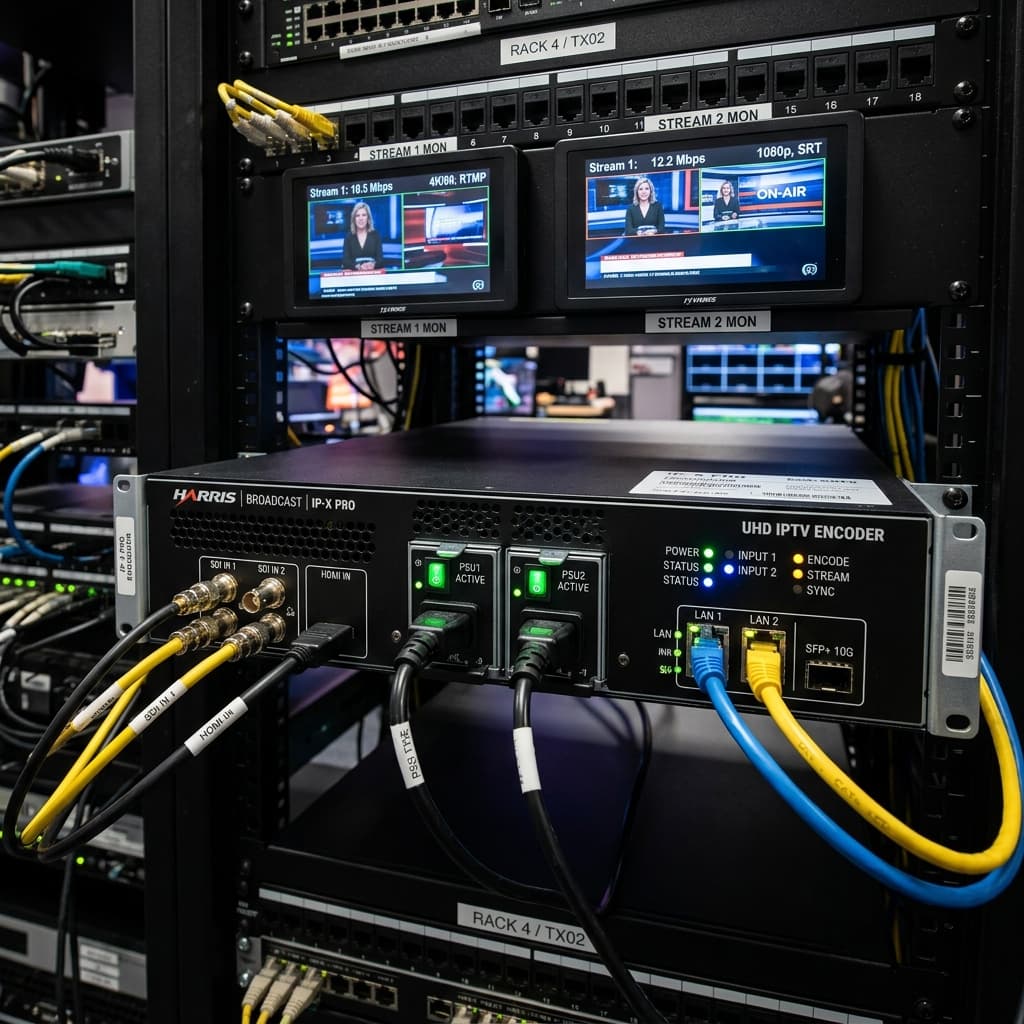
In contrast, a modular rack mount iptv encoder consolidates multiple encoding blade cards into a standard nineteen inch rack enclosure. Each blade inside the rack mount iptv encoder contains high performance hardware processing units dedicated to encoding multiple independent video channels simultaneously. Uncompressed HDMI or SDI video inputs enter the rear panel interfaces, where specialized hardware chipsets immediately compress each stream using H265 HEVC or H264 compression standards. The encoded video data is aggregated onto high speed internal backplanes and output via redundant Ethernet ports using standard IP protocols such as UDP multicast, SRT, RTSP, or HTTP. Dual redundant hot swappable power supplies and front to back cooling fan arrays ensure the rack mount iptv encoder operates continuously without overheating or single point electrical failure, making it the preferred choice for enterprise data centers.
## Essential Evaluation Criteria for Selecting Rack Mount IPTV Encoder Systems
Selecting the ideal rack mount video encoding system requires evaluating key technical parameters engineered for high volume digital media delivery. Here are the primary benchmarks that define an enterprise grade rack mount iptv encoder.
1. High Density Channel Capacity and Modular Expandability. Enterprise rack chassis allow a rack mount iptv encoder to support sixteen, thirty two, or sixty four independent video input channels within a compact one U or four U server rack space.
2. Advanced H265 HEVC Compression Algorithms. Implementing efficient H265 video encoding chipsets enables a rack mount iptv encoder to deliver clear four K Ultra HD and high definition picture quality while reducing network bandwidth consumption by up to fifty percent.
3. Redundant Power Supplies and Hot Swappable Hardware Modules. Dual AC power inputs and hot swappable encoder cards allow engineers to replace modules or power units without shutting down the entire rack mount iptv encoder chassis.
4. Comprehensive Network Transport Protocol Compatibility. Full support for enterprise streaming protocols including UDP multicast, SRT, RTSP, RTMP, and HTTP allows a rack mount iptv encoder to stream seamlessly into local IPTV headends or cloud distribution servers.
5. Centralized Web Management and SNMP Network Monitoring. An intuitive centralized web control panel and SNMP integration allow network administrators to monitor channel bitrates, fan speeds, and stream health for all channels in real time.
## Stream Transport Protocols and Network Optimization in Rack Mount IPTV Encoder Systems
Deploying high channel count video encoding systems across enterprise networks requires careful protocol selection and network traffic management. Broadcasting dozens of live video feeds simultaneously can quickly saturate local network bandwidth if transport protocols are improperly configured.
A professional rack mount iptv encoder overcomes network bottlenecks by offering flexible protocol mapping for each encoded video channel. For localized distribution within hotels, hospitals, or corporate facilities, configuring the rack mount iptv encoder to output UDP multicast or IGMP streams allows thousands of display screens to access live channels without consuming extra network bandwidth for each viewer. When transmitting live channel lineups over wide area networks or public internet backbones, configuring channels to use Secure Reliable Transport SRT ensures built in packet recovery, low latency transmission, and AES stream encryption. This flexibility enables a single rack mount iptv encoder chassis to feed both internal IPTV networks and remote cloud streaming platforms simultaneously.
## Integrating Rack Mount IPTV Encoder Technology with Eagle4k Infrastructure
While a high density rack mount iptv encoder provides local encoding horsepower, reaching nationwide or global subscriber bases requires a high capacity cloud distribution network. Relying on inadequate server infrastructure can cause stream buffering and channel latency for end users.
Pairing a rack mount iptv encoder with the Eagle4k cloud distribution platform creates a powerful broadcast pipeline. Eagle4k operates global edge server clusters equipped with Anti Freeze version nine acceleration software. When the output streams from a rack mount iptv encoder reach Eagle4k ingestion servers, Intelligent Traffic Routing dynamically routes the live channels across low latency fiber backbones directly to user displays. This integrated infrastructure guarantees ninety nine point ninety nine percent server uptime, instant channel changing response, and buffer free four K streaming performance for subscribers across Smart TVs, streaming sticks, and mobile devices.
## Step by Step Workflow for Configuring Rack Mount IPTV Encoder Appliances
Configuring a multi channel rack mount iptv encoder for live network broadcasting involves a systematic setup procedure. Follow these logical steps to bring your video channels online.
1. Mount the rack mount iptv encoder chassis securely into your nineteen inch server rack and connect both power cords to redundant power outlets.
2. Connect your HDMI or SDI video source cables into the corresponding input ports on the rear panel of the encoder cards.
3. Connect high speed Ethernet cables from the management and streaming network ports to your core network switch.
4. Power on the chassis and view the assigned IP address on the front LED panel or via your network DHCP lease table.
5. Open a web browser on your computer and navigate to the web administration dashboard using the encoder IP address.
6. Access the channel configuration menu to set the video codec to H265 HEVC and specify resolution and frame rate for each channel.
7. Configure stream output settings for each channel, assigning unique UDP multicast IP addresses or SRT destination URLs provided by your Eagle4k distribution panel.
8. Save the system profile and activate stream outputs to begin broadcasting high quality video feeds across your network.
## Frequently Asked Questions About Rack Mount IPTV Encoder Hardware
Question one. What is a rack mount iptv encoder and how does it differ from desktop encoders.
Answer. A rack mount iptv encoder is an enterprise grade hardware appliance designed to mount in standard server racks, consolidating multiple high density encoding cards into a single chassis with redundant power and centralized cooling.
Question two. How many video channels can a single rack mount iptv encoder process simultaneously.
Answer. Depending on the chassis size and modular card configuration, a rack mount iptv encoder can process anywhere from eight up to sixty four independent video channels in a single rack enclosure.
Question three. Why is hardware redundancy important in a rack mount iptv encoder.
Answer. Hardware redundancy such as dual hot swappable power supplies and redundant network ports ensures the rack mount iptv encoder maintains continuous operation even if a power source or network cable fails.
Question four. Can a rack mount iptv encoder output different streaming protocols for different channels.
Answer. Yes, an advanced rack mount iptv encoder allows independent protocol assignment per channel, allowing some channels to output UDP multicast locally while others stream via SRT to cloud servers.
Question five. Why is pairing a rack mount iptv encoder with Eagle4k recommended for broadcast networks.
Answer. Eagle4k delivers global cloud edge distribution, Anti Freeze version nine software technology, and high bandwidth network routing, ensuring all channels encoded by a rack mount iptv encoder reach end users with maximum stability and four K visual clarity.
## Summary and System Recommendations
In summary, selecting a enterprise rack mount iptv encoder is the definitive architectural choice for organizations requiring high density, reliable video encoding in centralized data centers. By combining modular chassis design, H265 HEVC compression, redundant power supplies, and multi protocol streaming support, rack mount encoding units deliver unmatched operational efficiency. Connecting your rack mount iptv encoder to the global cloud edge network at Eagle4k guarantees ultimate broadcast stability, ninety nine point ninety nine percent uptime, and pristine four K video streaming across all subscriber displays.
The enterprise broadcasting landscape is undergoing a massive migration as telecom operators, cable headends, hotel networks, and sports stadiums transition from bulky standalone video conversion boxes toward centralized high density hardware infrastructure. Encoding dozens or hundreds of live video feeds simultaneously requires a physical form factor optimized for server room racks, thermal management, redundant power supplies, and centralized network management. Deploying a rack mount iptv encoder represents the industry standard solution for ingesting raw video streams from multiple SDI or HDMI sources and outputting high quality IP streams across local and global networks. Evaluating rack mount iptv encoder appliances requires analyzing essential engineering benchmarks including channel density per rack unit, H265 HEVC hardware compression efficiency, hot swappable power modules, active cooling airflow design, and low latency streaming protocol integration. Professional multi channel encoding chassis must maintain crystal clear picture quality without signal degradation or system downtime during continuous broadcast operations. In this detailed technical analysis, we examine how rack mount iptv encoder systems process high volume media feeds, evaluate critical infrastructure parameters, detail step by step configuration workflows, answer common operator questions, and explain why pairing rack mount hardware encoders with the Eagle4k cloud network guarantees maximum uptime and pristine four K video distribution.
## Understanding the Chassis Architecture of a Rack Mount IPTV Encoder
To understand how high density video distribution operates, it is necessary to examine the structural and electrical engineering of a rack mount iptv encoder. In commercial broadcast facilities, using individual desktop video encoders leads to cable clutter, uneven thermal dissipation, power distribution chaos, and management inefficiencies.
In contrast, a modular rack mount iptv encoder consolidates multiple encoding blade cards into a standard nineteen inch rack enclosure. Each blade inside the rack mount iptv encoder contains high performance hardware processing units dedicated to encoding multiple independent video channels simultaneously. Uncompressed HDMI or SDI video inputs enter the rear panel interfaces, where specialized hardware chipsets immediately compress each stream using H265 HEVC or H264 compression standards. The encoded video data is aggregated onto high speed internal backplanes and output via redundant Ethernet ports using standard IP protocols such as UDP multicast, SRT, RTSP, or HTTP. Dual redundant hot swappable power supplies and front to back cooling fan arrays ensure the rack mount iptv encoder operates continuously without overheating or single point electrical failure, making it the preferred choice for enterprise data centers.
## Essential Evaluation Criteria for Selecting Rack Mount IPTV Encoder Systems
Selecting the ideal rack mount video encoding system requires evaluating key technical parameters engineered for high volume digital media delivery. Here are the primary benchmarks that define an enterprise grade rack mount iptv encoder.
1. High Density Channel Capacity and Modular Expandability. Enterprise rack chassis allow a rack mount iptv encoder to support sixteen, thirty two, or sixty four independent video input channels within a compact one U or four U server rack space.
2. Advanced H265 HEVC Compression Algorithms. Implementing efficient H265 video encoding chipsets enables a rack mount iptv encoder to deliver clear four K Ultra HD and high definition picture quality while reducing network bandwidth consumption by up to fifty percent.
3. Redundant Power Supplies and Hot Swappable Hardware Modules. Dual AC power inputs and hot swappable encoder cards allow engineers to replace modules or power units without shutting down the entire rack mount iptv encoder chassis.
4. Comprehensive Network Transport Protocol Compatibility. Full support for enterprise streaming protocols including UDP multicast, SRT, RTSP, RTMP, and HTTP allows a rack mount iptv encoder to stream seamlessly into local IPTV headends or cloud distribution servers.
5. Centralized Web Management and SNMP Network Monitoring. An intuitive centralized web control panel and SNMP integration allow network administrators to monitor channel bitrates, fan speeds, and stream health for all channels in real time.
## Stream Transport Protocols and Network Optimization in Rack Mount IPTV Encoder Systems
Deploying high channel count video encoding systems across enterprise networks requires careful protocol selection and network traffic management. Broadcasting dozens of live video feeds simultaneously can quickly saturate local network bandwidth if transport protocols are improperly configured.
A professional rack mount iptv encoder overcomes network bottlenecks by offering flexible protocol mapping for each encoded video channel. For localized distribution within hotels, hospitals, or corporate facilities, configuring the rack mount iptv encoder to output UDP multicast or IGMP streams allows thousands of display screens to access live channels without consuming extra network bandwidth for each viewer. When transmitting live channel lineups over wide area networks or public internet backbones, configuring channels to use Secure Reliable Transport SRT ensures built in packet recovery, low latency transmission, and AES stream encryption. This flexibility enables a single rack mount iptv encoder chassis to feed both internal IPTV networks and remote cloud streaming platforms simultaneously.
## Integrating Rack Mount IPTV Encoder Technology with Eagle4k Infrastructure
While a high density rack mount iptv encoder provides local encoding horsepower, reaching nationwide or global subscriber bases requires a high capacity cloud distribution network. Relying on inadequate server infrastructure can cause stream buffering and channel latency for end users.
Pairing a rack mount iptv encoder with the Eagle4k cloud distribution platform creates a powerful broadcast pipeline. Eagle4k operates global edge server clusters equipped with Anti Freeze version nine acceleration software. When the output streams from a rack mount iptv encoder reach Eagle4k ingestion servers, Intelligent Traffic Routing dynamically routes the live channels across low latency fiber backbones directly to user displays. This integrated infrastructure guarantees ninety nine point ninety nine percent server uptime, instant channel changing response, and buffer free four K streaming performance for subscribers across Smart TVs, streaming sticks, and mobile devices.
## Step by Step Workflow for Configuring Rack Mount IPTV Encoder Appliances
Configuring a multi channel rack mount iptv encoder for live network broadcasting involves a systematic setup procedure. Follow these logical steps to bring your video channels online.
1. Mount the rack mount iptv encoder chassis securely into your nineteen inch server rack and connect both power cords to redundant power outlets.
2. Connect your HDMI or SDI video source cables into the corresponding input ports on the rear panel of the encoder cards.
3. Connect high speed Ethernet cables from the management and streaming network ports to your core network switch.
4. Power on the chassis and view the assigned IP address on the front LED panel or via your network DHCP lease table.
5. Open a web browser on your computer and navigate to the web administration dashboard using the encoder IP address.
6. Access the channel configuration menu to set the video codec to H265 HEVC and specify resolution and frame rate for each channel.
7. Configure stream output settings for each channel, assigning unique UDP multicast IP addresses or SRT destination URLs provided by your Eagle4k distribution panel.
8. Save the system profile and activate stream outputs to begin broadcasting high quality video feeds across your network.
## Frequently Asked Questions About Rack Mount IPTV Encoder Hardware
Question one. What is a rack mount iptv encoder and how does it differ from desktop encoders.
Answer. A rack mount iptv encoder is an enterprise grade hardware appliance designed to mount in standard server racks, consolidating multiple high density encoding cards into a single chassis with redundant power and centralized cooling.
Question two. How many video channels can a single rack mount iptv encoder process simultaneously.
Answer. Depending on the chassis size and modular card configuration, a rack mount iptv encoder can process anywhere from eight up to sixty four independent video channels in a single rack enclosure.
Question three. Why is hardware redundancy important in a rack mount iptv encoder.
Answer. Hardware redundancy such as dual hot swappable power supplies and redundant network ports ensures the rack mount iptv encoder maintains continuous operation even if a power source or network cable fails.
Question four. Can a rack mount iptv encoder output different streaming protocols for different channels.
Answer. Yes, an advanced rack mount iptv encoder allows independent protocol assignment per channel, allowing some channels to output UDP multicast locally while others stream via SRT to cloud servers.
Question five. Why is pairing a rack mount iptv encoder with Eagle4k recommended for broadcast networks.
Answer. Eagle4k delivers global cloud edge distribution, Anti Freeze version nine software technology, and high bandwidth network routing, ensuring all channels encoded by a rack mount iptv encoder reach end users with maximum stability and four K visual clarity.
## Summary and System Recommendations
In summary, selecting a enterprise rack mount iptv encoder is the definitive architectural choice for organizations requiring high density, reliable video encoding in centralized data centers. By combining modular chassis design, H265 HEVC compression, redundant power supplies, and multi protocol streaming support, rack mount encoding units deliver unmatched operational efficiency. Connecting your rack mount iptv encoder to the global cloud edge network at Eagle4k guarantees ultimate broadcast stability, ninety nine point ninety nine percent uptime, and pristine four K video streaming across all subscriber displays.